

A Humans of Purpose Academy report
The Rebuild
An employer-led DFV recovery blueprint for government, industry bodies and employers of every size.
The gap
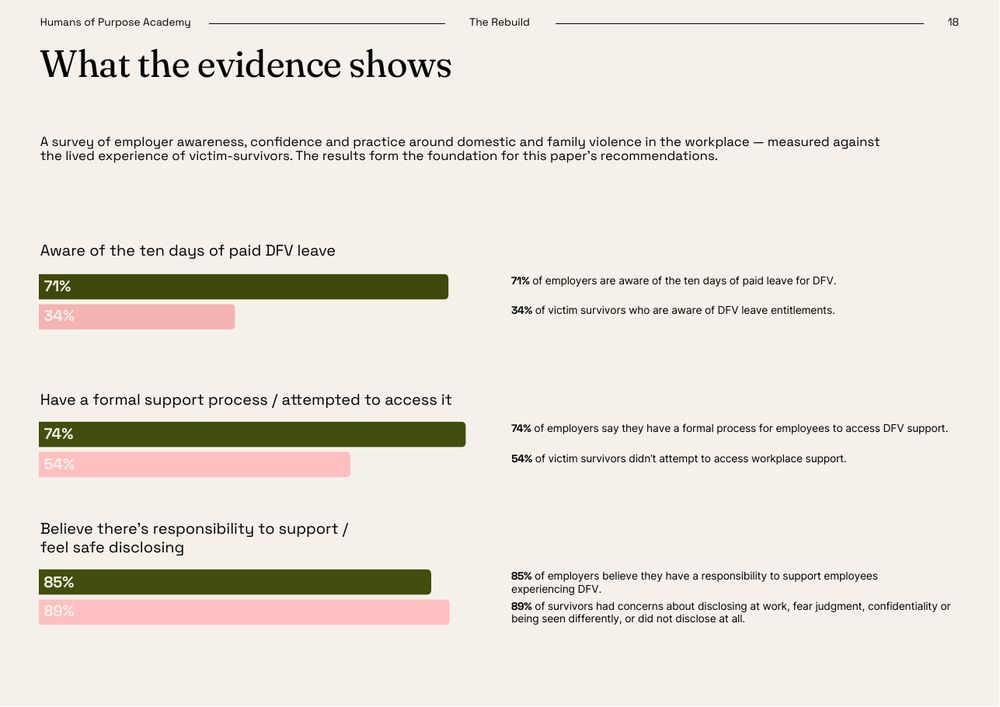
What employers think. What survivors know.
71%
of employers feel confident they could identify and respond to an employee experiencing DFV.
8.3%
of victim-survivors say their workplace actually took an active role in supporting them.
74%
of employers say they have a formal process for employees to access DFV support.
54%
of victim-survivors didn't attempt to access workplace support at all.
85%
of employers believe they have a responsibility to support employees experiencing DFV.
89%
of survivors had concerns about disclosing at work, or did not disclose at all.
That gap is why The Rebuild exists.
See what's insideFrom original YouGov research commissioned by Humans of Purpose, September 2026: 206 Australian employers and 505 people with lived experience of domestic and family violence.
About the report
Humans of Purpose Academy commissioned The Rebuild because we know what comes after leaving domestic and family violence: years of financial insecurity, disrupted employment and the slow work of rebuilding economic independence.
For most women, leaving is when the hardest work begins.
The Rebuild leverages academic insight, survey data and lived experience to outline five key recommendations for using employment to drive DFV recovery.
Our founder, Melanie Greblo, has her own experience of domestic and family violence. Since starting Humans of Purpose, she's watched the same story repeat: women do the hardest thing, they leave, and arrive on the other side to find the systems meant to catch them were never built to hold their weight, or were never built at all.
There are a lot of misconceptions about what recovery looks like. Trauma doesn't run on a tidy script or schedule. It doesn't switch off the day a lease is signed, or a restraining order is granted. Often the health and other impacts surface years later, long after the danger of leaving is over. A workplace that doesn't understand this becomes the next hurdle for a woman to overcome.
The Rebuild is our attempt to change that. The evidence is clear: kindness, honesty and flexibility aren't soft options. For most employers, they're the most powerful tools available. And every business can deploy them, regardless of size, sector or budget. But good intentions need infrastructure behind them. The recommendations in this paper are designed to build that infrastructure, giving employers the resources, incentives and support to act, and giving government a clear role in making it possible.

The biggest misconception is that when you leave, life is going to get easier. It isn't. I actually think recovery is the hardest part.
What's inside
Research, testimony, and a plan.
-
Original research
Australian employers' awareness, confidence and practice around DFV in the workplace, measured directly against the lived experience of victim-survivors.
-
First-person testimony
From survivors who rebuilt their life and career after leaving.
-
Five actionable recommendations
For government and employers.
-
A practical "kindness in action" guide
For supporting employees through DFV.
After reading The Rebuild, you'll have a clearer picture of your legal obligations, a practical framework for assisting employees experiencing DFV and a set of evidence-based actions, some for employers to take today, and some to demand of government.
The contributors
Built with the sector.
This report draws on in-depth interviews with sector leaders, researchers and advocates.

Christine Castley
Chief Executive Officer
Workplace Gender Equality Agency
Caitlin Davies
Head of Workforce and Sector Development
No To Violence

Rebecca Glenn
Founder and Chief Executive Officer
Centre for Women's Economic Safety
Jess Hill
Industry Professor
UTS

Claire Hurst
Director
White Ribbon Australia

Althea Mackenzie
Acting Chief Executive Officer
Women's and Girls' Emergency Centre

Kombe Musonda
Outreach Programs Manager
Zonta House Refuge Association

Dr Lata Satyen
Associate Professor, School of Psychology
Deakin University

Dr Kate Seymour
Researcher, College of Human Sciences and Culture
Flinders University

Livia Stanton
Senior Policy & Advocacy Officer
Domestic Violence NSW
Heike Stephan
Access Program Lead
Women's and Girls' Emergency Centre

Chantelle Stratford PSM
Principal Gender Specialist
VOX FEMINA
The respect of the human first, and then what you can do, and your responsibility for the appropriate level and size of your organisation.

Until we measure recovery by whether women with lived experience of DFV are genuinely thriving, not just employed or not just housed, we will keep mistaking the beginning of a woman's story for its end.
Get the report
Read The Rebuild.
Leave your name, email and phone number and we'll send the full report to your inbox.
We'll only use your details to send you the report and, now and then, news from the Academy. No spam, and you can unsubscribe any time.
Thank you.
Please check your email for your link to the report. We look forward to growing conversations around employer-led DFV recovery.